I’m writing this in the middle of a fast. Not the pretty kind people post about — the kind where you catch yourself reaching again for the sugar, the bread, the something, to fill a space food was never meant to fill. The kind where you look up and realize you’ve been quietly running from yourself one bite at a time.
And I’m writing it roughly ninety days out from turning fifty.
It’s week four of Wisdom in the Trees — the Nourished Wolf — and here I am, face to face with the very thing I’m meant to be teaching. If you want the universe to show you where you’re still asleep, stand in front of a room and teach nourishment. The mirror shows up fast.
I could write this as the teacher. I’ve learned that would be a lie, and not a useful one. So I’ll write as the student — the only honest thing any of us ever is.
A couple of weeks ago I heard a conversation that stopped me. Dr. Zach Bush, on Aubrey Marcus’s podcast, was asked: if you had one message of healing for the world, what would it be? His answer was one word.
Reconnect.
Then he spent an hour saying, in a doctor’s words, what I’ve been living and teaching from my own body for years. He said healing is a restoration of relationships — that nothing outside the body can actually heal the body, only reconnection can. He said emotion is the “high-fructose corn syrup of feelings” — a mirror image of a real feeling the body can’t metabolize, so it has to store it. And he said the wound underneath every addiction is abandonment.
That last one is the one that reached into my chest.
Because when I look, honestly, at my own reaching for indulgent foods and sugar — no shame, no story — what I find underneath it is old. It’s the part of me that learned, a long time ago, that I was allowed to be useful but not seen. That I mattered for what I did, not who I was. And food — sweet, quick, always there — was a way to be held when I didn’t know how to ask to be held.
That’s what addiction is. Not a moral failure. A wound. A small, ancient orphan inside us, reaching for whatever’s nearest, because nobody told it it was safe to be seen.
So I live with the awareness of the five F’s. Fascia — the body’s memory, storing what the mind forgot. Feelings — energy in motion, or energy stuck. Frequency — the coherence we only feel in safe company. Food — information, not morality. Focus — because what we feed grows.
And while fear is one of the F-words that has often been paralyzing, I’ve also learned that facing it helps to diffuse it.
This is why I’m not eating right now. Not to punish the part of me that reached for sugar — that would be more of the same, more criticism, more abandonment. I’m fasting to listen. To get quiet enough to hear what the reaching was trying to say.
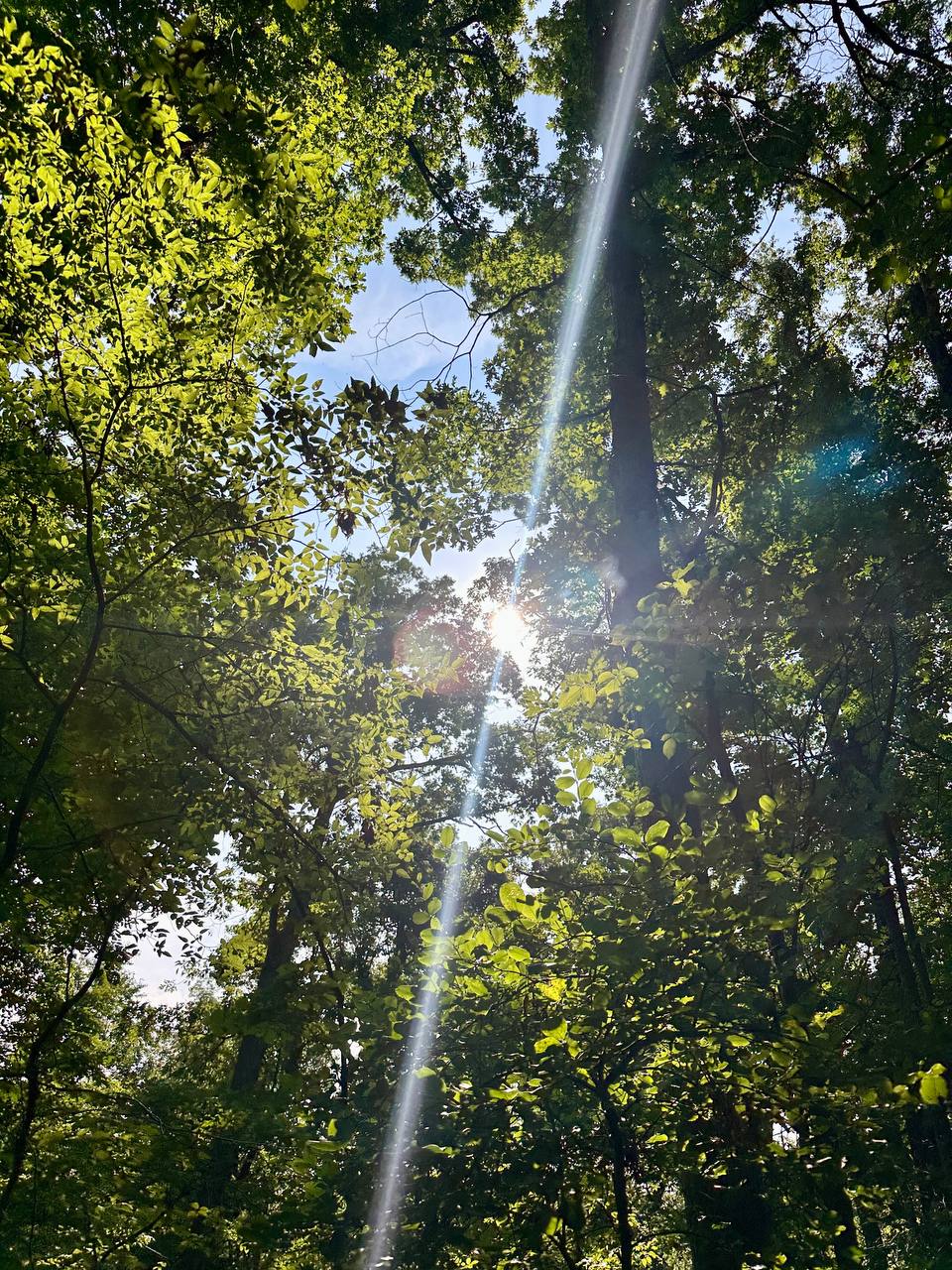
The plants taught me this first. In the jungle, sitting with them, I watched the forest grow around its own knots — not erasing them, keeping them, letting them become part of the story. In my backyard, the old oak doesn’t judge its knots. Neither should I.
Fifty years. Most of them spent doing, producing, proving. And this much I now know: you don’t get home to your body by working harder at it. You get home by stopping long enough to be welcomed back.
There’s another truth I’m carrying into this turning, one we don’t name nearly enough: my body is changing. Menopause is here, or close enough to it — a whole season of the body rearranging itself — and for a long time I met it the way I met everything else. With critique. With the wish that it would be different. With a running scorecard of what my body used to be.
But here’s what the fast, the plants, and the wolves keep teaching me: I don’t get to come home by arguing with the house. Self-acceptance isn’t something I earn once I fix myself. It’s the doorway — the thing I walk through first, as I am, mid-transition, softer and wider and more me than I’ve ever been.
And that is self-love, it turns out. Not a reward for the body I wish I had, but a decision to hold the body I actually have.
So here’s my one message, the one I’m still learning to live: Reconnect. Come home to the body you’ve been leaving. It’s been trying to reach you the whole time — through the sugar, through the ache, through the fascia that remembers what your mind forgot. The way back isn’t more willpower, or more shame, or more information. It’s relationship. With your body. With the earth. With each other, around a table of faces.
It’s about time I did.
The plants call us home to the earth. The body is how we walk there.
— Christy